
Tuesday, March 3rd
To complete today's challenge, find time to prayerfully read through the reflections below, attend a recovery meeting, and share what's on your heart and mind on today's discussion board.
 REFLECT
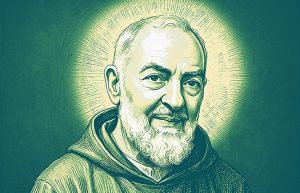
Memorial of Saint Pius of Pietrelcina, Priest
To those troubled, afflicted, or in need, the saint we celebrate today, Saint Pio, offers a simple formula for life: “Pray, hope, and don’t worry.” These five short words provide a potent remedy for our own troubles and struggles. Saint Pio prayed continually throughout his life, turning to the rosary as a continual source of support. He also reached the highest levels of contemplative prayer through the celebration of Holy Mass. These are the same basic means to which we all have access. We merely need to take action and put prayer into practice.
As for hope, there were countless events in Saint Pio’s life that would have left anyone without hope. His physical sufferings were one thing, but he was also persecuted by his own brethren in the monastery, probed by scientists, and called a fraud. He was not permitted to preach at Mass and essentially lived under house arrest for years. But amid this, he joyfully carried out his duties with hope in God’s care.
The fruit of a hopeful attitude is, therefore, not to worry. When we have hope in the power of God and in the presence of Jesus, we can surrender our fears, anxieties, and concerns and live without the nagging worries that drag us down. Saint Pio’s ministry did not end with amazing miracles. His care for the sick moved him to build a hospital and his care for the faithful put in him the confessional for many hours every day. He is a great model who shows us how hope, prayer, and action can work together for the glory of God. Saint Pio, pray for us!
Reflection Questions
- How can you hope, pray, and not worry as much today?
- How do you balance hope, prayer, and action in your life?
Daily Mass Readings
First Reading: Proverbs 30:5-9
Responsorial Psalm: Psalm 119:29, 72, 89, 101, 104, 163
Gospel: Luke 9:1-6
Reflection by Bill B.
Saint Pius of Pietrelcina (Padre Pio), Priest
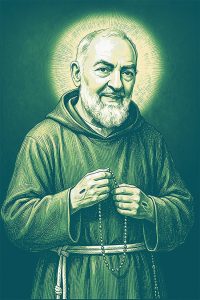 (1887-1968) — Born as Francesco Forgione to a southern Italian farming family, he joined the Capuchin Franciscans at 15 and was ordained at 22. Saint Pio is one of the most well-known saints today. He had extraordinary mystical gifts of the stigmata, reading of consciences, bilocation, miraculous healing, interpretation of languages, physical fights with the demonic, and much more.
“Prayer and charity, this is the most concrete synthesis of Padre Pio’s teaching” (Pope Saint John Paul II, canonization homily, June 16, 2002). His life was a model for blending Steps 11 and 12. Prayer and charity. Can you authentically have one without the other as a Catholic?
“Stay with me, Lord, for it is necessary to have You present so that I do not forget You. You know how easily I abandon You. Stay with me, Lord, because I am weak and I need Your strength, that I may not fall so often. Stay with me, Lord, for You are my life and without You I am without fervor. Stay with me, Lord, for You are my light and without You I am in darkness. Stay with me, Lord, to show me Your will” (Prayer of Saint Padre Pio after Communion).
Reflection by Brad Farmer
Other Saints
Discuss
Share your thoughts and connect with others on this journey.
Log in to join the discussion.
Fear keeps me in bondage for not knowing how to let go and let God. I want to turn my will over to God but I do not know how to. I pray and pray and pray but I still hold on tight to something that I do not want. I want to give it all to God. Please my Lord take it from me, you be in control. Please pray for me to let go and let God!
Fear of the opinion of others has kept me in AA from sharing my story which is one of a catholic experiencing periodic spiritual battle for my soul. I now turn to God in pray "Lord, empty me, fill me, use me" whenever my thoughts turn negative, and I have included it and the Litany for Humility into my morning prayers. For me this has been working very well.
I’ve pretended to be okay, capable and at full capacity. I tumbled pretty far down.
* How does fear keep you in bondage to self-will and how might you turn your will and life over to Christ, the true master, each and every day this Lent?
Fear of my husband of vulnerability of what could happen. Fear of losing this life I’ve worked so hard to build. Fear of losing my independence, having to do things I don’t feel like or want to do with/for husband. Bondage of self will… it definitely makes it really hard to see what is good, what I need to do, what I need to let go of, with the right thing to do is. I can only pray and every day ask thy will not mine. Be willing to see past the fear, be willing to operate from a place of love and not fear and not control.