


Tuesday, February 24th
To complete today's challenge, find time to prayerfully read through the reflections below, attend a recovery meeting, and share what's on your heart and mind on today's discussion board.
 REFLECT


Twenty-fifth Sunday in Ordinary Time
This Sunday's Gospel Reading shares a story about the temptation to compare ourselves with others. Theodore Roosevelt once remarked that comparison is the thief of joy. In addition to the emotional cost, making these comparisons can prevent us from seeking the help we need and can potentially harden our hearts as we see God’s abundant grace fill the lives of others.
Last week, we discussed the cost of resentment, which often comes as a result of comparison and expectations set upon God and others. Listen as Jesus describes the generosity of God and the dangers of a heart hardened by comparison as he tells a parable of hired laborers working in a vineyard:
The landowner asks, “Are you envious because I am generous?” (Matthew 20:15). That question reaches into recovery. Comparison can make us forget what God has already done because we become preoccupied with how someone else’s story is unfolding. We may wonder why another person found sobriety sooner, why their family seems to be healing faster, or why they appear to experience a spiritual freedom that still feels distant to us.
Underneath comparison is often the belief that grace should work like a scorecard. If we have worked harder or been faithful longer, part of us expects that God should reward us accordingly. The opposite can happen too. We may believe we arrived too late, failed too many times, or wasted too much of our lives to receive what others have found.
The first reading challenges both ways of thinking: “For my thoughts are not your thoughts, nor are your ways my ways, says the Lord” (Isaiah 55:8). We tend to calculate what seems fair. God continues going into the marketplace, looking for people who are still standing there and inviting them into His vineyard. His generosity toward someone else does not reduce what He has given us.
This does not mean effort is irrelevant. Every worker still has to enter the vineyard. Recovery requires action. We show up and work the Steps. We tell the truth, make amends where needed, and keep doing the next right thing. But these practices are responses to grace. They are not ways of putting God in our debt or proving that we deserve more than someone else.
Gratitude helps loosen comparison’s grip. Instead of asking why another person received something we wanted, we can ask what God has placed in our hands today. Perhaps it is another day of sobriety or simply the willingness to begin again. Gratitude does not deny what we still long for. It keeps longing from becoming resentment.
There is also great hope in the workers who arrive late. No one needs to conclude that they have missed their chance. Some of us find recovery after decades of addiction. Others return after relapse or after years of trying to manage alone. The landowner keeps going out. God’s invitation remains.
Saint Paul writes in the second reading, “For to me life is Christ” (Philippians 1:21). Recovery eventually leads us beyond measuring ourselves against one another. Our deepest question is not whether we are doing better or worse than someone else, but whether our lives are becoming more rooted in Christ.
There is no shortage of mercy in God’s vineyard. Whether we arrived early or late, the invitation is the same: receive what God is giving, do the work placed before us, and learn to rejoice when grace finds someone else too.
Reflection Questions
- Where has comparison been making you less grateful for the grace God is already giving you?
- Do you tend to believe that you have worked hard enough to deserve more, or that you have failed too much to receive what God wants to give?
- What would it look like this week to receive your own place in God’s vineyard with gratitude and genuinely rejoice in another person’s progress?
Sunday Mass Readings
First Reading: Isaiah 55:6-9
Responsorial Psalm: Psalm 145:2-3, 8-9, 17-18
Second Reading: Philippians 1:20c-24, 27a
Gospel: Matthew 20:1-16a
Download printable meeting reflections:
General Recovery | Recuperación General
Family & Friends Recovery | Recuperación para Familiares
Lust Addiction Recovery | Recuperación de Adicción Sexual
ACDH Recovery | Recuperación HAHD
Download virtual meeting reflections:
General Recovery | Recuperación General
Family & Friends Recovery | Recuperación para Familiares
Lust Addiction Recovery | Recuperación de Adicción Sexual
ACDH Recovery | Recuperación HAHD
Saints Andrew Kim Taegon, Priest and Martyr, Paul Chong Hasang, Martyr, and Companions, Martyrs
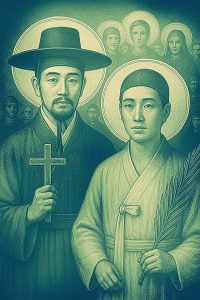 (d.1791-1867) — Hundreds of Korean martyrs are remembered today. They were priests, missionaries, and lay people, men and women, young and old. The Christian community in Korea “was founded entirely by lay people. This fledgling Church, so young and yet so strong in faith, withstood wave after wave of fierce persecution. Thus, in less than a century, it could already boast of some ten thousand martyrs” (Pope Saint John Paul II, canonization homily, May 6, 1984). Saints Andrew and Paul were leaders in the budding community. Andrew, the first Korean priest, was tortured and beheaded in 1846. Paul was a lay leader who was martyred in 1839.
How hard are we willing to fight for our faith? How hard are we willing to fight for our recovery? Both thrive in community. What can we do today to strengthen these communities where we live?
“Saint Peter writes: ‘You were ransomed…not with perishable things such as silver or gold, but with the precious blood of Christ’. To this lofty price, to this price of the Redemption, your Church desires, on the basis of the witness of the Korean Martyrs, to add an enduring witness of faith, hope and charity” (Pope Saint John Paul II, canonization homily, May 6, 1984).
Reflection by Brad Farmer
Other Saints


Discuss
Share your thoughts and connect with others on this journey.
Log in to join the discussion.
I do not struggle to forgive because I know that in order for me to be forgiven I need to forgive. Its after forgiving someone that I struggle with. Resentment and grudges that I need to let go. MY LORD AND MY GOD heal me from resentment and the grudges I hold. AMEN
During my 45+ years of periodic binge drinking there are numerous (too many to count) times when I realized that if God wasn't protecting me, I would be dead or would be in jail. I had most of the time during this period a sort of close relation with God and my faith, so prayer, trust and hope were eventually what pulled me out of each binge period. Only under God's mercy and protection was this possible. I never forget what God has done for me and how He when I finally cooperated, He gave the gift of AA, Calix, and now CIR.