To complete today's challenge, find time to prayerfully read through the reflections below, attend a recovery meeting, and share what's on your heart and mind on today's discussion board.
REFLECT
After reading today's reflections, make sure to listen to Phil M.'s personal reflection.
Good morning, Friend
November 11
Daily Reflection
Saint of the Day
Daily Reflection
Memorial of Saint Martin of Tours, Bishop
Saint of the Day
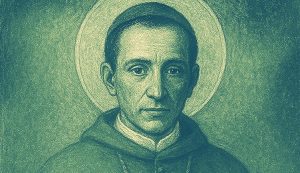
Saint Martin of Tours, Bishop
Memorial of Saint Martin of Tours, Bishop
As we see in today’s Gospel reading, Jesus appreciates the gratitude of the humble and is hurt by the coldness of egoism. We read, “As he was entering a village, ten lepers met him. They stood at a distance from him and raised their voice, saying, ‘Jesus, Master! Have pity on us!’ And when he saw them, he said, ‘Go show yourselves to the priests.’ As they were going, they were cleansed. And one of them, realizing he had been healed, returned, glorifying God in a loud voice; and he fell at the feet of Jesus and thanked him. He was a Samaritan. Jesus said in reply, ‘Ten were cleansed, were they not? Where are the other nine? Has none but this foreigner returned to give thanks to God?’” (Luke 17:11-18)
Jesus exemplified not only the theological virtues but also the “social” virtues—virtues that demonstrate respect for one another—of gratitude, kindness, and joy throughout His ministry. He also taught us the importance of friendship, cordiality, temperance, love of the truth, understanding of one another, loyalty, industriousness, and sincerity.
The Twelve Steps form us similarly. By seeking recovery through the Steps, we learn to practice social virtues like honesty, patience, humility, brotherly love, integrity, service, and others. Social virtues make daily life more pleasant and draw us closer to God as well as help us, by God’s grace, embody the supernatural virtues of love, hope, and faith. In fact, Pope Saint John Paul II speaks similarly in one of his papal addresses about the gift of practicing social virtues:
“Elizabeth’s start of joy at the Visitation emphasizes the gift that can be contained in a mere greeting when it comes from a heart full of God. How often can the darkness of loneliness, oppressing a soul, be dispelled by the shining ray of a smile and a kind word! A good word is soon said; yet sometimes we find it difficult to utter. We are restrained by fatigue, we are distracted by worries, we are checked by a feeling of coldness or selfish indifference. Thus, it happens that we may pass by persons, although we know them, without looking at their faces and without realizing how often they are suffering from that subtle, wearing sorrow which comes from feeling ignored. A cordial word, an affectionate gesture could be enough, and something would at once awaken in them: a sign of attention and courtesy can be a breath of fresh air in the stuffiness of an existence oppressed by sadness and dejection. Mary’s greeting filled with joy the heart of her elderly cousin Elizabeth” (“Address,” February 11, 1981).
Our friends and family members long for kindness, cheerfulness, and encouragement. I feel at peace when I am understood and warmly encouraged, especially when my defects and mistakes are apparent. And I have also learned through my recovery that people thirst for my smile and little compliments—I know I thirst for theirs. Therefore, let us always be looking to bring a spirit of joy and gratitude to all we encounter in our lives. As Saint Paul puts it, “In all circumstances, give thanks, for this is the will of God for you in Christ Jesus” (1 Thessalonians 5:18).
Reflection Questions
How does it make you feel when you are complimented or treated with joy by others? What can you do today to make others feel the same way?
Can you think of three ways to add peace to those in your life by practicing social virtues?
Daily Mass Readings
First Reading: Titus 3:1-7 Responsorial Psalm: Psalm 23:1b-3a, 3bc-4, 5, 6 Gospel: Luke 17:11-19
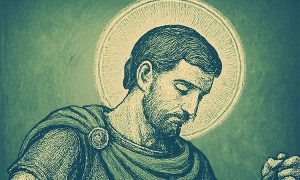
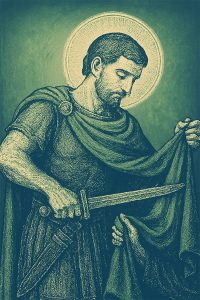
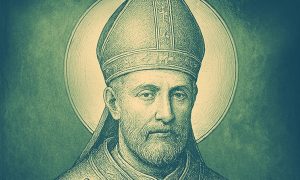
(c.316-397) — Martin was born to pagan parents in modern-day Hungary and moved to Italy when his father was transferred as a military officer for the Roman Empire. He started to learn about Catholicism as a catechumen, but put his learning on hold when he entered the Imperial army at 15. At 18, Martin encountered a freezing beggar, gave him half his cloak, perceived him as Christ in a later vision, and was baptised. He left the army two years later, became a disciple of Saint Hilary of Poitiers, lived as a hermit, and helped establish a Benedictine monastery. He eventually became Bishop of Tours in modern-day France. Martin was the first non-martyr to be titled “saint.”
“May St. Martin help us to understand that only by means of a common commitment to sharing is it possible to respond to the great challenge of our times: to build a world of peace and justice where each person can live with dignity” (Pope Benedict XVI, Angelus, November 11, 2007). How do you live Step 12?
“Lord, if your people need me, I will not refuse the work. Your will be done” (Saint Martin of Tours).
Other Saints
Saint Leo the Great, Pope and Doctor of the Church
November 10, 2025
Saint Elizabeth of the Trinity
November 9, 2025
Blessed John Duns Scotus
November 8, 2025
Saint Peter Wu, Martyr
November 7, 2025
Blessed Thomas Ochia Jihyoe, Martyr
November 6, 2025
Blessed Bernhard Lichtenberg, Priest and Martyr
November 5, 2025
Saint Charles Borromeo, Bishop
November 4, 2025
Saint Martin de Porres
November 3, 2025
The Commemoration of All the Faithful Departed (All Souls)
Share your thoughts and connect with others on this journey.
Phil M. shares about how tapping into God's power helps him remain sober. What does God's power concretely look like for you in your recovery and faith?
I do pray daily for God to grant me strength, courage, and wisdom to get through each and every day. I also pray for Him to help me keep my sobriety, acknowledging that I cannot do it without Him.
Joe Camacho8 months ago
I pray daily for God to keep me sober in my codependency. I pray that I will surrender to Gods will. None of this can I do alone, I need God always.
1
Looking for support?Connect with others who understand your journey.



 REFLECT