

Friday, February 27th
To complete today's challenge, find time to prayerfully read through the reflections below, attend a recovery meeting, and share what's on your heart and mind on today's discussion board.
 REFLECT
After reading today's reflections, make sure to listen to Marene C.'s personal reflection.
Seventeenth Sunday in Ordinary Time
Recovery often begins with a single decision, but it is sustained by countless smaller ones. We decide to ask for help, attend a meeting, call a sponsor, begin working the Twelve Steps, or return to the sacraments after years away. Those first decisions matter, but they are only the beginning. Lasting recovery is built through a daily willingness to keep choosing the path that leads to freedom.
This Sunday's gospel presents three short parables about the Kingdom of Heaven (Matthew 13:44-52). In two of them, Jesus describes a man who discovers a treasure hidden in a field and a merchant who finds a pearl of great price. In both cases, the response is immediate. Each person "goes and sells all that he has" in order to possess the treasure he has found.
These parables ask a simple but searching question: What is worth giving everything for?
For many of us, addiction once answered that question. We sacrificed time, relationships, integrity, health, and peace in pursuit of something that continually promised satisfaction but never delivered it. Recovery gradually reverses that pattern. Instead of giving everything to what enslaves us, we begin offering our lives to the One who brings lasting freedom.
This is why recovery cannot be sustained by half-hearted commitment. The Big Book of Alcoholics Anonymous states plainly, “Half measures availed us nothing” (p. 59). Those words are not meant to shame us but to describe reality. Freedom grows as we become fully willing. We cannot cling tightly to our old way of life while expecting to experience the fullness of the new one.
That willingness is renewed one day at a time. Step Three invites us to turn our will and our lives over to the care of God, not once, but repeatedly. Step Eleven deepens that surrender through prayer and meditation, helping us seek God’s will rather than our own. These daily practices keep our hearts oriented toward the treasure we have discovered.
This does not mean we never struggle with competing desires. Even after embracing recovery, we can become distracted by comfort, success, approval, or the illusion that we no longer need the practices that helped us begin healing. We may find ourselves drifting rather than deliberately choosing the life God has placed before us. The parables remind us that what is most valuable deserves our full attention.
King Solomon offers another example in the first reading (1 Kings 3:5, 7-12). When God invites him to ask for anything, Solomon requests wisdom rather than power or riches. He recognizes that the greatest gift is not possessing more but seeing rightly. Recovery asks for the same kind of wisdom. We learn to recognize what truly leads to life and what only appears valuable for a moment.
Over time, our priorities begin to change. Prayer becomes less of an obligation and more of a necessity. Meetings become a source of strength rather than another item on the calendar. Service becomes an expression of gratitude instead of duty. These changes do not happen because we force them. They grow as our hearts become convinced that Christ truly is the greatest treasure we could possess.
The Kingdom of Heaven is not something we stumble upon once and then forget. It is a treasure we choose again each day. As we continue in recovery, we are invited to renew that choice with gratitude and conviction, trusting that nothing we surrender for Christ can compare to what He freely gives in return.
Reflection Questions
- What competes with Christ and your recovery for first place in your life today?
- How have your priorities changed since you first entered recovery?
- What is one concrete way you can choose the “pearl of great price” this week instead of settling for something less?
Sunday Mass Readings
First Reading: 1 Kings 3:5, 7-12
Responsorial Psalm: Psalm 119:57, 72, 76-77, 127-128, 129-130
Second Reading: Romans 8:28-30
Gospel: Matthew 13:44-52
Download printable meeting reflections:
General Recovery | Recuperación General
Family & Friends Recovery | Recuperación para Familiares
Lust Addiction Recovery | Recuperación de Adicción Sexual
ACDH Recovery | Recuperación HAHD
Download virtual meeting reflections:
General Recovery | Recuperación General
Family & Friends Recovery | Recuperación para Familiares
Lust Addiction Recovery | Recuperación de Adicción Sexual
ACDH Recovery | Recuperación HAHD
Saints Joachim and Anne
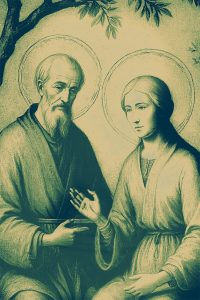 (First century BC) — The parents of the Immaculate Virgin Mary, grandparents of Jesus Christ, are not known from historical or canonical writings but from the tradition of the Protoevangelium of James, also called the Infancy Gospel of James, likely written during the mid- to late-second century. Tradition has them as elderly when Mary was born, and that they gave her in service to the temple in Jerusalem at three years old as a perpetual consecrated virgin.
While we can’t have as high a degree of certainty regarding the details of their lives, we know that Mary, the Immaculate Conception, had parents, and that they must have been chosen by God. We can look to them as inspiration and intercessors for family life with God at the center. Where do we need intercession in our family life? How have our relationships grown or changed in recovery? Is God at the center?
“Joachim and Anne, how chaste a couple! While leading a devout and holy life in your human nature, you gave birth to a daughter nobler than the angels, whose queen she now is” (from a sermon by Saint John Damascene).
Reflection by Brad Farmer
Other Saints
Discuss
Share your thoughts and connect with others on this journey.
Marene shares today about the importance of making amends for our faith and recovery. Share about an experience of making amends and how it affected your recovery and faith.
Log in to join the discussion.
The graces that stand out to me the most are a much deeper relationship with God, tremendous internal peace and internal joy.